

Although the Road Runner always got the best of Wile E Coyote, coyotes are pretty amazing animals. They can run up to 43 mph, control how many pups they have in a litter based on food availability, and use 11 different ways of communicating. There are 19 subspecies of coyotes that live in every state except for Hawaii, and they can even mate with wolves and dogs. And apparently, they have ACME on speed dial…LOL.

Coyotes are most active at dusk and dawn. Why? Their favorite prey—deer—are also most active at this time. Coyotes will hunt deer, but they will also be perfectly happy with roadkill as well. Coyotes are not picky eaters by any means—they’ll eat whatever is available—rabbits, rodents, berries, fruits and vegetables and grasses. They will even eat rattlesnakes if they wander too close to their den.
Coyotes go by many, many different names. Some pronounce the name KIGH-oh-tee and some say it KIGH-oat. They are also known as prairie wolves, brush wolves and American jackals. The original name for the coyote derived from the Aztec name ‘coyotl’ which was corrupted somewhat by the Spanish language and became ‘coyote.’ The character ‘Coyote’ is an important cultural phenomenon in many indigenous people’s cultures. This character is described as a trickster and is often portrayed as being greedy or dishonest. Still, in some Native American cultures, Coyote is revered as teaching children important life lessons about survival and life in general.
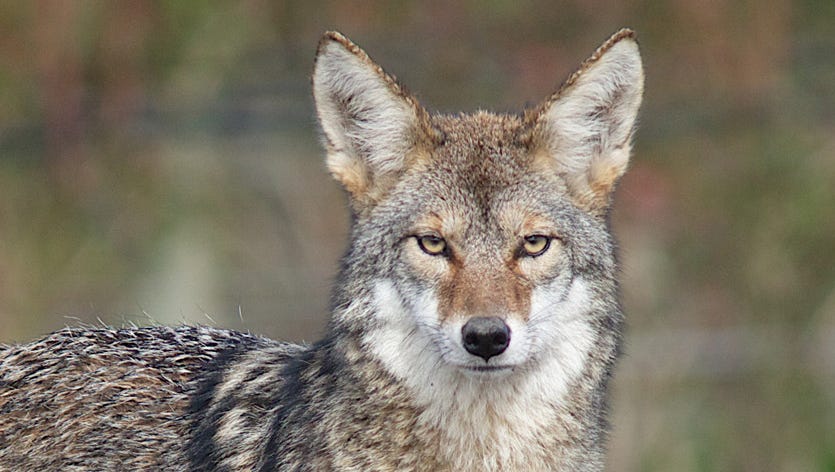
Physically, coyotes are also amazing! Coyotes are very comfortable in the dark. Their powerful night vision comes from the abundance of rod receptors in their eyes. These respond to low levels of light, as opposed to cones which respond to high levels of light. They also have a mirror beneath their retinas called a tapetum lucidum. It reflects the observed light twice, giving the eye a better chance of seeing even in low-light conditions.
And their hearing is tremendous! The shape of their ears is meant to capture even the smallest of movement. They can hear up to a quarter mile away! During the wintertime, a coyote can hear a mouse moving beneath 7 inches of snow!

To thrive as well as the coyotes have, they must be equipped with top-notch sight, hearing, and smell. Luckily for coyotes, they have all three. Coyotes have been known to be weirded out by even the subtlest of scents. Their natural instinct to avoid danger makes their sense of smell that much more important, especially when it comes to smelling people or hunters. Coyotes also use smell, more than sight, to identify pack members. While sight is only used to detect movement, coyotes depend more on hearing and smell to find their prey.
Which brings us to sound. Coyotes don’t just make noise to make noise. Each sound has a different purpose. The two most distinct sounds a coyote can make are barks and howls. Howls seem to be more for communicating information to other pack members, or to warn outsider coyotes not to enter a pack’s territory. Barks and yips seem to be more related to assessing how far away other pack members are or to attract the attention of other pack members.
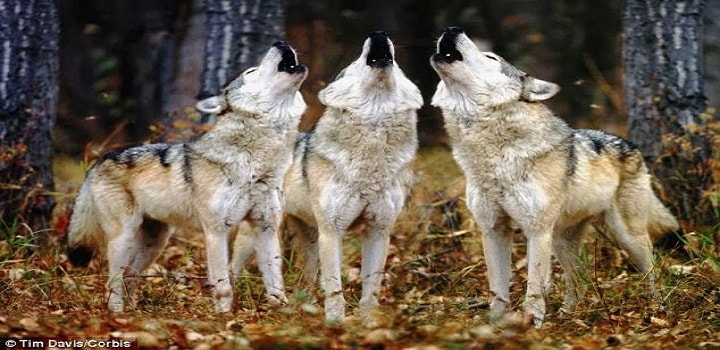
The fur of a coyote can be gray, red or yellow-brown mixed with black. Many coyotes will even change fur colors throughout the seasons. Regional environments can also influence a coyote’s fur color. Typically, the color on the back is darker than the color on the stomach and legs.
A pack of coyotes is called a band even though coyotes rarely hunt in larger units unless they’re taking down a larger prey like a deer. They stay active during the winter too, forgoing a cozy den. And speaking of dens, when picking a den location, coyotes will often find a hollow between rocks or build a burrow in the soil. When they decide to go the burrow route, they’ll often find abandoned fox or badger burrows and expand on those instead of making their own. Coyotes, however, will create dens to raise their pups in. Once the rearing season is over, coyotes often move aboveground. They sleep in densely wooded areas where they won’t be observed by humans or bigger predators.
Coyotes can jump fences—as high as 3 feet, but cannot climb trees. While this may not sound impressive, coyotes have been known to scale fences as high as 14 feet and can jump just as far across if they have momentum built up. Not the cartoon characters we assume them to be at all.

 Sew Colorful
Can’t help but wonder if the jab played a roll
LikeLiked by 1 person
Farm time
LikeLiked by 1 person
LikeLiked by 1 person
LikeLiked by 1 person
Just planted the roses….
The deer are eating them…
Well that was nice while it lasted.
LikeLiked by 1 person
Morning kea! and Mom and pup!
i had miniature rose bushes at our old house…the deer would never touch them till the buds were on–they loved the buds…I tried this spray called Deer Off–smelled liked rotten eggs. kept the deer and EVERYBODY away!!
LikeLiked by 1 person
😅😂 it’s a never ending battle
LikeLiked by 1 person
IT IS!
whenever I tried to plant something “new”…the deer would ALL have to taste it…even if one ate it and in disgust left–the rest were like…I gotta try that for myself! by the time the while herd tried it, there was nothing left…
if it came up agin…they went back–thinking it was new…i gave up!
LikeLiked by 1 person
Yup!
I’ve lost too much stuff that way
LikeLiked by 1 person
LikeLiked by 1 person
thanks for the morning videos!
LikeLiked by 1 person
🥰
LikeLiked by 1 person